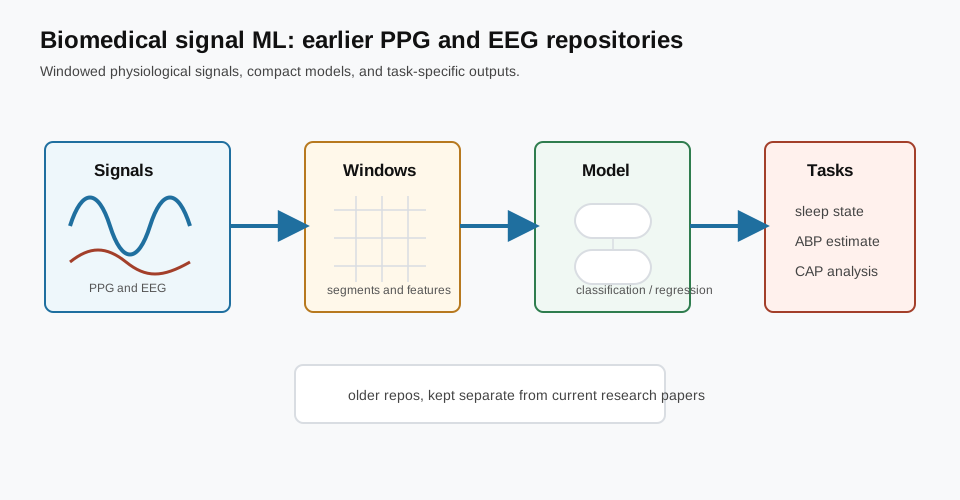
This page groups older physiological-signal ML projects. They are useful as evidence of applied ML range, but they should not be read as current clinical software. I am keeping that boundary explicit because health-adjacent ML needs tighter claims than ordinary portfolio copy.
How to read this page
- PPG to ABP: waveform-estimation prototype around photoplethysmography signals.
- Sleep/awake classification: PPG feature classification for state prediction experiments.
- EEG CAP analysis: older EEG analysis work grouped with the same signal-ML track.
- Boundary: research prototypes only; no clinical, diagnostic, or medical-device claim.
The shared signal pipeline
The common workflow is signal windowing, feature construction, model training, and evaluation against a task-specific output. The details differ between PPG and EEG, but the engineering problem is similar: noisy physiological time series need careful preprocessing before a model result means much.
This is why I keep the project line separate from current research papers. These repos show earlier applied ML range, not a current claim that the models should be used for decisions about someone's health.
public work
-
Sleep-Awake Classification using PPG
Earlier classification prototype around sleep/awake state signals from PPG features.
related writing
- Blood Pressure Estimation Using PPG Signals · Medium, Jan 22, 2023
What held up and what I would change now
The part that held up is the decomposition: start with signal windows and features before making model claims. The part I would change today is the evidence bar. For health-adjacent ML, I would document data provenance, splits, leakage checks, calibration, error bands, and intended non-use more explicitly before publishing a polished project page.
Project artifacts
- ABP Estimation using PPG repository.
- Sleep-Awake Classification using PPG repository.
- CAP using EEG repository.
- Blood Pressure Estimation Using PPG Signals Medium walkthrough.